
- Resolution Center: A web-based dashboard where you can view, monitor, and manually respond to disputes.
- Disputes API: A programmatic interface that enables you to automate dispute management actions directly from your systems.
This guide applies to direct merchants and connected integrations where merchants handle disputes and chargebacks and assume financial liability.
Key features
- Structured dispute lifecycle: Handle disputes efficiently through defined stages from submission to resolution with a clearly defined workflow that minimizes ambiguity and supports efficient, timely resolution.
- No-code solution: Simplify dispute handling with Resolution Center, a ready-to-use web interface that requires no technical integration.
- Automated operations: Scale dispute management, reduce manual effort, and save time with Disputes API that works seamlessly with your existing systems.
- Amicable resolution option: Engage directly with buyers through messaging on our platform to resolve disputes, avoiding escalation and associated fees.
Understand disputes
You can use the information in this section to get familiar with PayPal’s dispute management process. This helps you understand and manage disputes effectively.Parties involved in dispute management
The following table outlines the key parties involved and their roles in the dispute management process:Types of disputes
PayPal classifies disputes into internal and external disputes based on where they originate and who manages adjudication.Internal disputes
When a buyer files a dispute using the PayPal Resolution Center, it becomes an internal dispute (or internal case). The buyer and merchant can communicate directly through PayPal’s platform to resolve the dispute amicably without PayPal’s intervention. If they cannot reach an agreement, either party may escalate the dispute to a claim, where PayPal reviews and adjudicates the case based on submitted evidence.- The buyer has 180 days from the payment date to dispute a transaction.
- PayPal holds the disputed payment until resolution.
- The buyer and merchant have up to 20 days to resolve the disputes amicably. If either party escalates the dispute to PayPal, it will review the case and adjudicate within 10 days based on the evidence from both parties. Both merchants and buyers can appeal unfavorable decisions.
The buyer can also file a dispute using the PayPal chatbot, IVR, or by calling customer support.
External disputes
When a buyer files a dispute with their bank or card issuer, it becomes an external dispute (or external case). The bank or card issuer manages and adjudicates the outcome. PayPal acts solely as an intermediary to transmit information and evidence between the merchant and the bank or card issuer.Types of external disputes
- Chargeback: A chargeback occurs when the buyer disputes a charge with their debit or credit card issuer, who reverses the payment and refunds the buyer.
The merchant can also receive a pre-chargeback alert, which is a notification about a potential chargeback. Merchants can issue a refund within 20 hours without fulfilling the order to avoid the chargeback and associated fees.
- ACH return: A bank reversal (or ACH return) occurs when the bank requests PayPal to reverse a payment.
Dispute lifecycle and stages
Understanding the dispute lifecycle helps you manage disputes more efficiently. Disputes typically progress through these stages:- Inquiry stage: The buyer files a dispute. PayPal provides a platform for merchants and buyers to resolve disputes directly without its intervention. If the dispute remains unresolved, either party may escalate it to a claim. Item/service not received (INR) or significantly not as described (SNAD) issues begin in the inquiry stage, and if unresolved, may escalate to the claim stage.
- Claim stage: Once the dispute is escalated to a claim, PayPal requests the evidence from both parties, and reviews the submitted evidence. Issues such as billing errors, duplicate charges, or unauthorized transactions are handled directly as claims.
- Dispute resolution stage: For internal disputes, PayPal adjudicates and communicates the resolution to both parties. For external disputes, the bank or card issuer adjudicates the case and communicates the resolution to PayPal.
For detailed information, see Understand dispute lifecycle stages.
Common buyer issues
The following table summarizes the common buyer issues that lead to disputes:How disputes work
This section provides an overview of the internal and external dispute workflows.Internal disputes
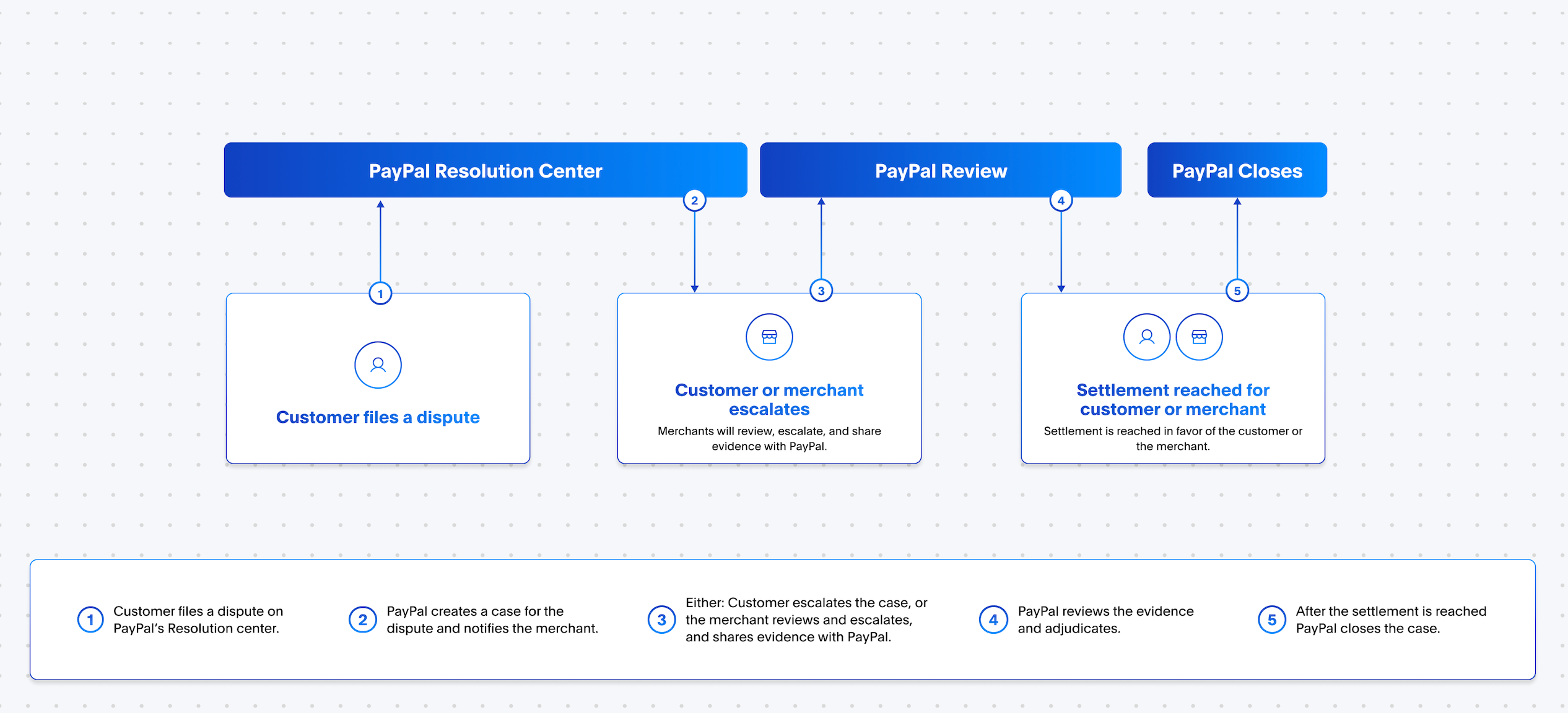
- Buyer: Files a dispute for a transaction with PayPal.
- PayPal:
- Creates a case for the dispute and holds the disputed payment.
- Notifies the merchant.
- Merchant:
- Reviews the dispute details and gathers necessary information and evidence.
- Responds to the dispute. This may include full or partial refunds, offers, supporting information, or escalation of the dispute to a claim.
- Buyer:
- Reviews the response.
- Accepts the offer or reviews the supporting information and closes the dispute, or rejects it and escalates the dispute to a claim.
- PayPal (if escalated to claim):
- Requests evidence from the merchant and buyer.
- Adjudicates based on the evidence from both parties.
- If resolved in the buyer’s favor, PayPal refunds the transaction amount.
- If resolved in the merchant’s favor, PayPal releases the hold on the transaction amount.
- Updates dispute status and communicates the resolution to the merchant.
- Merchant | Buyer: [Optional] Appeals the resolution and provides additional evidence for further review.
External disputes
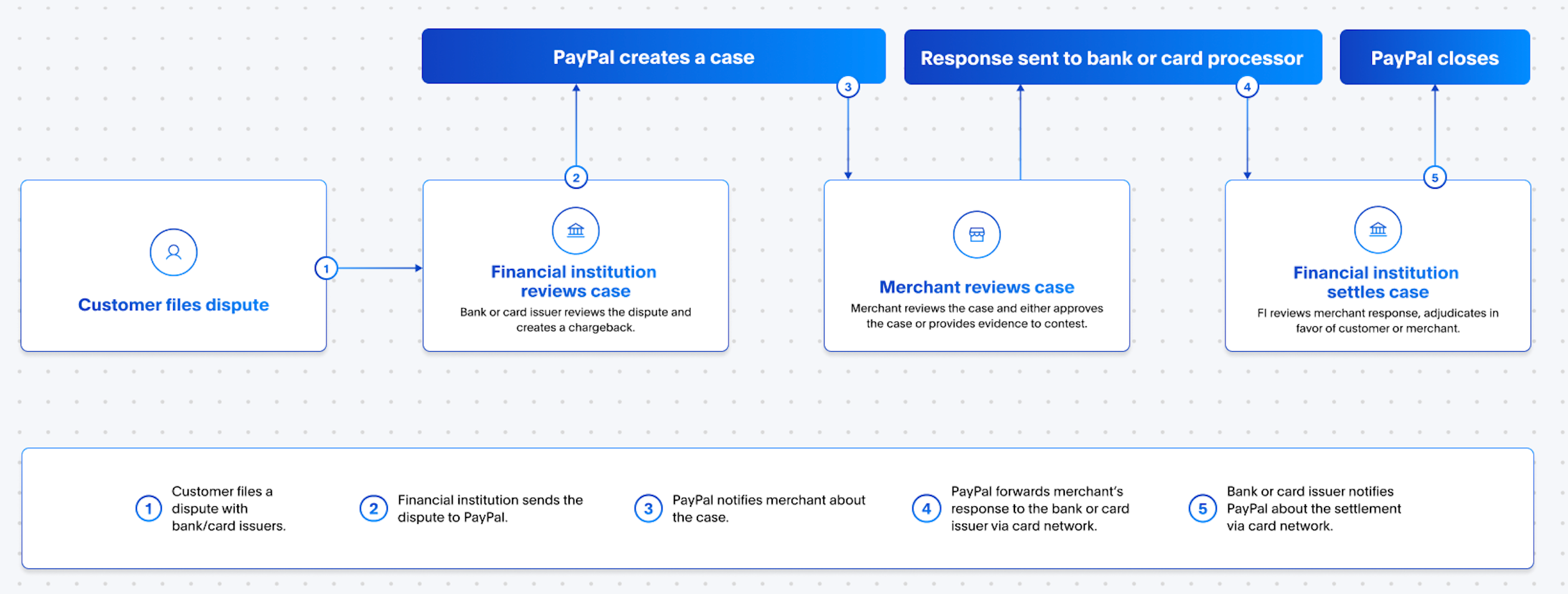
- Buyer: Files a dispute for a transaction with the bank or card issuer.
- Bank | Card issuer: Reviews the buyer’s claim. If valid, sends a chargeback through the card network to PayPal.
- PayPal:
- Creates the dispute case.
- Notifies the merchant.
- Merchant:
- Reviews the dispute details.
- Responds to the dispute by issuing a refund or submitting evidence to PayPal.
- PayPal: Forwards the merchant’s response through the card network to the bank or card issuer.
- Bank | Card issuer:
- Reviews and adjudicates based on the evidence from both parties.
- If resolved in the buyer’s favor, the bank or card issuer refunds the transaction amount.
- If resolved in the merchant’s favor, the bank or card issuer reverses the transaction amount.
- Communicates the resolution through the card network to PayPal.
- Reviews and adjudicates based on the evidence from both parties.
- PayPal: Updates dispute status and notifies the merchant.